Enterprise AI Gateway Platform: Top Features to Know
An enterprise AI gateway platform is the control layer that sits between every team in your organization and the hundreds of AI models they want to use, replacing a tangle of vendor accounts with one secure, governed API. For companies scaling AI adoption, this matters enormously because unmanaged API keys, shadow AI tools, and inconsistent security review create real compliance exposure. In this guide, we go far beyond the basics — covering what an enterprise AI gateway platform actually does, how it differs from a traditional API gateway, the exact governance mechanics that keep it audit-ready, deployment models for regulated environments, and a practical rollout plan you can follow this quarter. Throughout, we use AOCore, AOCyber's unified AI gateway, as a concrete working example.
Direct answer: An enterprise AI gateway platform is a single, OpenAI-compatible API that routes requests to hundreds of AI models while enforcing one consistent set of security, governance, observability, and cost policies. It replaces scattered, ungoverned vendor integrations with one managed, auditable connection point — and it is quickly becoming the missing piece in most companies' AI strategies.
What Is an Enterprise AI Gateway Platform?
An enterprise AI gateway platform is a unified layer that connects an organization to many AI models while applying one consistent set of security, governance, and cost controls. Instead of each department integrating directly with OpenAI, Anthropic, or an open-source model, every request flows through a single gateway that checks policy before anything reaches a model.
In practice, this looks like an OpenAI-compatible endpoint, similar in shape to a standard application programming interface that your developers already know how to call. However, instead of talking to one vendor, the gateway sits in front of 500 or more models and decides, request by request, where traffic should go. As a result, switching providers becomes a configuration change rather than a code rewrite, and security teams gain one place to review every AI interaction across the company.
Specifically, an enterprise AI gateway platform is not just a proxy that forwards requests. It actively inspects, tokenizes, rate-limits, logs, and routes each call, which is why it functions as infrastructure rather than a feature bolted onto one application.
An enterprise AI gateway platform acts as the single secure checkpoint between applications and hundreds of underlying AI models.
Enterprise AI Gateway vs. Traditional API Gateway: What's Actually Different
A common point of confusion is assuming that any API gateway can handle AI traffic. In contrast, a traditional API gateway was built to route HTTP requests to known, stable microservices — it was never designed to understand prompts, tokens, model-specific rate limits, or the unpredictable cost profile of a large language model call. An enterprise AI gateway platform, by comparison, speaks the language of AI workloads natively.
The table below summarizes where the two diverge in practice.
| Capability | Traditional API Gateway | Enterprise AI Gateway Platform |
|---|---|---|
| Routing logic | Path or host-based rules | Model-aware routing across 500+ providers |
| Rate limiting | Request count per second | Token-based budgets per team, model, or project |
| Content inspection | None | PII tokenization, jailbreak and prompt-injection detection |
| Failover behavior | Health checks on fixed endpoints | Automatic fallback to an alternate model on timeout or outage |
| Cost visibility | Bandwidth and request volume | Per-token spend broken down by team and model |
Consequently, bolting AI traffic onto a legacy gateway usually means missing exactly the controls that matter most for AI risk: content inspection, token-aware budgets, and model-level failover. An enterprise AI gateway platform is purpose-built to close that gap from day one.
Why Growing Enterprises Need a Unified AI Gateway
As soon as more than one team starts experimenting with AI, usage tends to spread faster than policy can keep up. One department adopts a chatbot API, another connects a model to internal documents, and finance has no clear view of total spend. Therefore, a unified AI gateway gives leadership one dashboard instead of a dozen disconnected vendor invoices.
Gartner has noted that generative AI adoption inside enterprises has grown dramatically in just a few years, moving from a niche experiment to a near-universal business tool. In contrast to that pace of adoption, most security and procurement processes were never designed to review dozens of separate AI vendors at once. A gateway closes that gap by centralizing review, so new model access can be approved in days instead of months.
Our related guide on building a multi-model AI strategy goes deeper into how teams should think about combining providers instead of locking into one model vendor, and our extended playbook on the multi-model strategy framework walks through the decision criteria step by step.
Why a Gateway Is the Foundation of a Complete Enterprise AI Strategy
Above all, an AI strategy that stops at "which model should we use" is only half finished. Specifically, most enterprise AI initiatives move through three predictable stages: experimentation, where a few teams try tools independently; pilot, where one use case gets budget and oversight; and scale, where AI touches customer data, regulated workflows, and revenue systems.
Without a gateway, the jump from pilot to scale is where most strategies break. Suddenly, dozens of applications each need their own security review, their own cost tracking, and their own compliance sign-off. In contrast, a gateway-first strategy absorbs that complexity at the infrastructure layer, so scaling to a new team or a new model is a policy update rather than a new project.
In other words, an enterprise AI gateway platform is not an add-on to your AI strategy — it is the layer that makes the rest of the strategy executable, auditable, and defensible to a board or a regulator.
Core Capabilities of a Modern AI Gateway Solution
A capable AI gateway solution generally needs to deliver several things at once: broad model access, strong governance, real-time observability, intelligent reliability controls, and developer-friendly integration. Specifically, look for support for 500 or more models through one endpoint, so teams are never blocked waiting on a new direct integration.
- Single API surface — one OpenAI-compatible endpoint for every connected model.
- Governance built in — PII tokenization, content guardrails, and policy enforcement applied automatically.
- Budget controls — spend limits and usage reporting by team, project, or model.
- Flexible deployment — cloud, self-hosted, or dedicated infrastructure depending on data sensitivity.
- Semantic caching — repeated or near-identical prompts are served from cache instead of re-querying a model, cutting cost and latency.
- Automatic failover — if a primary model times out or returns an error, traffic shifts to a backup model without the application noticing.
- Observability and tracing — every request is logged with latency, token usage, and routing decisions for audit and debugging.
AOCore, AOCyber's gateway, applies this model directly: it routes to 500+ models through one OpenAI-compatible API while AOSentry handles security checks in the background. You can review the full technical reference in the AOCore documentation, or see the product overview on the AOCore platform page for a plain-language breakdown of plans and features.
Semantic Caching and Failover: Why Reliability Matters
Latency and uptime are easy to overlook until an outage at a single model provider takes down a customer-facing feature. Semantic caching, which recognizes when two prompts are asking essentially the same question even if worded differently, reduces redundant model calls and speeds up response times. Meanwhile, automatic failover means a provider outage degrades gracefully to a backup model rather than returning an error to the end user. Together, these two features turn an AI gateway into reliability infrastructure, not just a routing convenience.
How Governance and Security Work Inside the Gateway
Security cannot be an afterthought bolted onto an AI gateway platform; it has to run on every single request. In practice, this means checking outbound text for sensitive personal data before it ever leaves the organization's control, a process known as PII tokenization, which temporarily replaces sensitive values with placeholder tokens.
Preventing Prompt Injection and Data Leaks
Prompt injection is a technique where attackers hide instructions inside content an AI model processes, trying to make it ignore its original guardrails. The OWASP Top 10 for Large Language Model Applications lists this among the most serious risks facing AI deployments today. Consequently, a gateway that screens for jailbreak attempts and injection patterns at the API layer, rather than relying on each application to catch them, closes a gap most teams would otherwise miss entirely.
The NIST AI Risk Management Framework similarly recommends continuous monitoring of AI systems rather than one-time review, which is exactly what centralized gateway logging makes possible. Our post on content guardrails for agentic AI covers this in more depth for teams running autonomous AI workflows.
Observability, Audit Trails, and Zero Trust Architecture
In addition to blocking bad requests, an enterprise AI gateway platform needs to prove what happened after the fact. Specifically, every request should generate a trace record covering which model handled it, how many tokens were used, what latency occurred, and whether any guardrail triggered. This level of detail aligns naturally with open observability standards such as OpenTelemetry, which many engineering teams already use for application tracing.
Furthermore, a zero trust approach — where no request is implicitly trusted regardless of where it originates — fits naturally inside a gateway architecture, since every call already passes through one inspection point. The CISA Zero Trust Maturity Model outlines this principle for federal systems, and the same logic applies directly to AI traffic moving through an enterprise gateway.
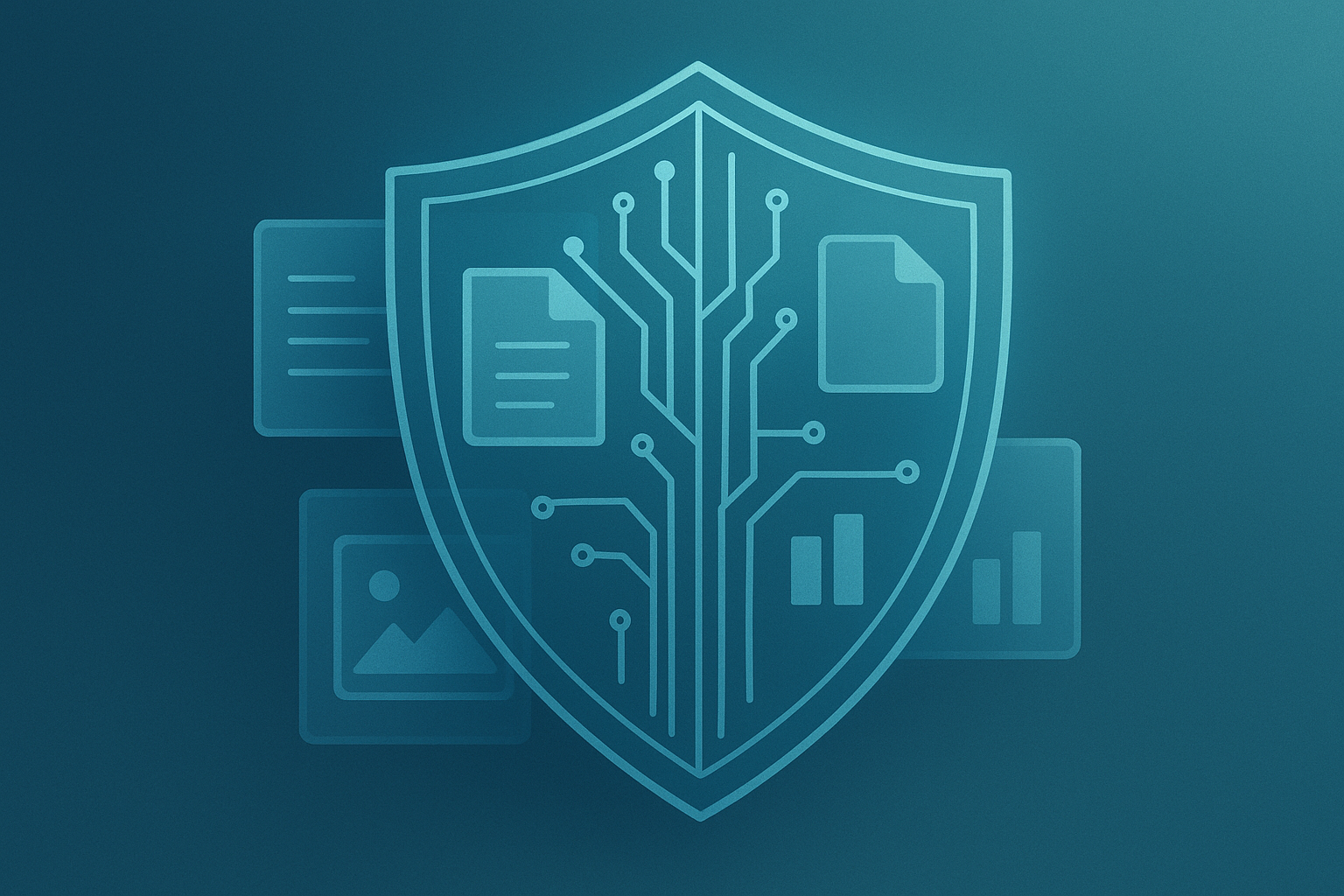
Governance controls like tokenization and guardrails run on every request before it reaches a model.
Government and Regulated Industry Use Cases
Above all, regulated organizations need proof, not promises, that an AI gateway can meet their compliance obligations. For defense and intelligence customers, that can mean IL5-deployable environments, CNSA 2.0 post-quantum cryptography, and CMMC Level 3 alignment, along with air-gapped or SCIF-capable deployments and CAC/PIV authentication for classified work.
Healthcare, finance, and other regulated sectors face a lighter but still meaningful version of the same problem: proving that sensitive data never leaves an approved boundary. Our guide to AI for regulated industries walks through a gateway-first approach in more detail, including how classified content detection and self-hosted deployment reduce exposure. For a deeper operational breakdown, our companion resource on the gateway-first compliance approach covers audit evidence and control mapping in more detail.
Deployment Models: Cloud, Self-Hosted, and Air-Gapped
Not every organization has the same risk tolerance, so an enterprise AI gateway platform should offer real choice in how it is deployed rather than a one-size-fits-all cloud service.
- Cloud deployment — fastest to launch, fully managed, ideal for pilots and most commercial use cases.
- Self-hosted deployment — the organization controls the infrastructure and data residency, suited to finance and healthcare workloads.
- Air-gapped deployment — fully isolated from external networks, required for classified or SCIF environments with CAC/PIV authentication.
Similarly, pricing and support structures should scale with deployment complexity, since an air-gapped rollout naturally requires more engineering coordination than a cloud pilot.
Build vs. Buy: Why Most Enterprises Don't Build Their Own Gateway
It is technically possible to build a basic internal proxy that forwards calls to a few models. However, replicating tokenization, jailbreak detection, per-model failover, token-based budgeting, and audit-ready logging is a multi-year engineering investment, not a weekend project.
In particular, the ongoing maintenance burden is often underestimated: every new model provider requires updated integration code, every new compliance requirement requires updated policy logic, and every security incident requires updated detection rules. As a result, most enterprises find that an established enterprise AI gateway platform reaches production-grade governance faster and at a fraction of the cost of an internal build.
How to Choose an Enterprise AI Gateway Platform
Choosing the right enterprise AI gateway platform comes down to matching deployment options and governance depth to your actual risk profile, not just comparing model counts. Therefore, start by asking whether your data can live in a shared cloud environment or whether it legally needs to stay self-hosted or air-gapped.
Next, check whether the vendor trains on customer data or monetizes usage in any way; a gateway that keeps you owning your own data is a meaningfully different product than one that does not. Finally, confirm pricing is tiered rather than all-or-nothing, since most organizations want to pilot before committing to a full enterprise contract with dedicated infrastructure and an SLA. You can explore available plans directly at aocyber.ai.
A Quick Evaluation Checklist
- Does it support 500+ models through a single OpenAI-compatible endpoint?
- Does it apply PII tokenization and jailbreak detection automatically on every request?
- Can it deploy self-hosted or air-gapped if your compliance tier requires it?
- Does it offer token-based budget controls by team, project, and model?
- Does it provide automatic failover and semantic caching for reliability?
- Is pricing tiered, with a path to pilot before full enterprise commitment?
Steps to Deploy an AI Gateway Infrastructure
Rolling out gateway infrastructure works best as a staged process rather than a single company-wide switch. The following steps outline a practical rollout order.
- Audit current AI usage. Identify every team, application, and API key already connecting to external AI models so nothing gets left routed around the new gateway once it goes live.
- Define governance policies. Set PII tokenization rules, content guardrails, and budget limits before connecting any live traffic through the gateway's control layer.
- Connect model providers. Route existing calls to OpenAI, Anthropic, or open-source models through the gateway's single OpenAI-compatible endpoint instead of separate direct integrations.
- Pilot with one team. Test latency, logging accuracy, and guardrail behavior with a single department before expanding access company-wide.
- Roll out and monitor. Expand access gradually while reviewing usage dashboards, cost reports, and security alerts weekly to catch issues early.
Where AODex, Eden Biz, and DevFlow Fit Around the Gateway
A gateway is infrastructure, not an end-user product, so most organizations pair it with tools people actually work inside every day. AODex, AOCyber's private AI workspace, runs on the same gateway and adds persistent memory, knowledge-base search, tuned personas, and conversation export for individual users and teams.
Meanwhile, businesses running operations on top of AI often need more than chat. Eden Biz is an AI-native business suite that combines CRM, HR, finance, projects, inventory, and document management on one data layer with role-based access, rather than stitching together separate tools. For developers, DevFlow offers a free, open-source Claude Code plugin for spec-driven development, giving engineering teams atomic commits and verification steps without any telemetry or required account.
A Growing Need for Unified AI Infrastructure
Industry analysts have tracked a sharp rise in enterprise generative AI usage over the past several years, and that trend shows no sign of slowing. Similarly, security incidents tied to ungoverned AI tool usage have become a recurring theme in enterprise risk reports. In light of that, treating the gateway layer as core infrastructure, rather than an afterthought, is quickly becoming standard practice rather than a competitive edge.

Centralized dashboards make it easier for teams to track usage after deploying an enterprise AI gateway platform.
Frequently Asked Questions About Enterprise AI Gateway Platforms
What is an enterprise AI gateway platform?
An enterprise AI gateway platform is a unified API layer that routes requests to many AI models while applying consistent security, governance, and cost controls. It replaces dozens of separate vendor integrations with one managed connection point.
How does an enterprise AI gateway platform work?
It intercepts every AI request before it reaches a model, applies policy checks such as PII tokenization and guardrails, then routes the request and logs the response. This happens behind a single OpenAI-compatible endpoint, so application code rarely needs to change.
Why do enterprises need a gateway instead of direct model access?
Direct access leaves every team managing its own API keys, security review, and spend, which quickly becomes unmanageable at scale. A gateway centralizes those controls so security and finance teams have one place to monitor usage.
What is the difference between an AI gateway and an AI workspace?
An AI gateway is infrastructure that routes and governs API traffic between applications and models, while an AI workspace is the end-user interface people work inside, such as AODex. Many organizations use both together.
What is the difference between an enterprise AI gateway platform and a traditional API gateway?
A traditional API gateway routes HTTP traffic using path or host rules and has no awareness of tokens, prompts, or model behavior. An enterprise AI gateway platform adds model-aware routing, token-based rate limiting, content inspection, and automatic failover built specifically for AI workloads.
Does an enterprise AI gateway platform improve latency and reliability?
Yes, features like semantic caching reduce redundant model calls, and automatic failover shifts traffic to a backup model during an outage or timeout. Together, these reduce both average response time and the risk of a single provider outage affecting end users.
What is semantic caching in an AI gateway platform?
Semantic caching recognizes when two prompts are asking substantially the same question, even if worded differently, and serves a cached response instead of calling the model again. This lowers both cost and latency for repeated or similar queries.
How does an AI gateway handle failover and load balancing across models?
If a primary model times out, errors, or exceeds a latency threshold, the gateway automatically reroutes the request to a predefined backup model. Load balancing can also distribute traffic across multiple models or providers to avoid rate-limit bottlenecks.
Why is an AI gateway considered essential to an enterprise AI strategy?
Without a gateway, scaling AI past the pilot stage means managing security, cost, and compliance separately for every application, which quickly becomes unworkable. A gateway makes an AI strategy executable by centralizing governance at the infrastructure layer instead of the application layer.
How much does an enterprise AI gateway platform cost?
Pricing typically follows tiered plans based on usage volume, model access, and support level, with dedicated infrastructure and SLAs available for larger deployments. Costs vary enough that most vendors recommend a demo or trial to scope actual usage first.
How long does it take to deploy an AI gateway?
A cloud-based pilot can often be running within days, since teams only need to point existing API calls at the new endpoint. Full organization-wide rollout, including policy tuning, usually takes several weeks.
What security risks does an AI gateway help prevent?
A well-built gateway helps prevent accidental PII exposure, jailbreak and prompt-injection attacks, and unmonitored shadow AI spend. It does this through tokenization, content guardrails, and centralized logging applied before any request reaches a model.
What are common mistakes when adopting an AI gateway?
The most common mistakes are rolling guardrails out to every team at once without piloting, and skipping an audit of existing shadow AI usage first. Both tend to cause friction and incomplete policy coverage later.
What is AOSentry and how does it relate to governance?
AOSentry is the built-in security and governance layer inside AOCore that handles PII tokenization, content guardrails, and jailbreak or prompt-injection detection. It applies these checks automatically to every request passing through the gateway.
Can an enterprise AI gateway platform support government and defense use cases?
Yes, government-grade gateway deployments can support IL5-deployable environments, CNSA 2.0 post-quantum cryptography, and CMMC Level 3 alignment for DoD, IC, and DIB organizations. Air-gapped and SCIF-capable deployments with CAC/PIV authentication are also available for classified environments.
What is the difference between cloud and self-hosted gateway deployment?
Cloud deployment is faster to launch and is managed by the vendor, while self-hosted deployment gives an organization full control over infrastructure and data residency. Regulated or classified environments usually require self-hosted or air-gapped options.
Does an AI gateway replace the need for a private AI workspace?
No, a gateway and a workspace solve different problems and typically work together. The gateway governs model traffic across all applications, while a workspace like AODex gives individual users persistent memory and knowledge-base search.
Is an enterprise AI gateway platform only useful for large companies?
No, smaller and growing businesses benefit as well, since governance and cost control become harder to manage manually as soon as more than one team starts using AI tools. Tiered pricing generally lets smaller teams start small and scale up.
Final Thoughts
Ultimately, an enterprise AI gateway platform is what turns scattered, risky AI experimentation into something a security team can actually sign off on. By routing every model request through one governed API, organizations gain visibility, consistent guardrails, reliable failover, and room to adopt new models without rebuilding their integrations each time. Whether you are a small team standardizing your first AI workflow or a government agency planning an air-gapped rollout, the core idea stays the same: govern once, connect everywhere. Starting with a usage audit and a focused pilot, as outlined above, gives most teams a realistic path toward adopting an enterprise AI gateway platform without disrupting the work already underway.

