Self-hosted business management software lets a company run its CRM, HR, finance, and operations tools on servers it controls instead of a vendor's shared cloud. For growing teams and regulated organizations alike, that distinction often matters as much as the features inside the platform. This guide explains how self-hosted business management software works, why data ownership matters, and what to evaluate before choosing a platform such as Eden Biz.
Quick answer: Self-hosted business management software is a CRM, HR, finance, and operations suite installed on infrastructure the organization owns or privately controls, rather than on a shared public cloud. It gives businesses direct control over data storage, security configuration, and compliance posture.

Private infrastructure gives organizations direct oversight of their self-hosted business management software.
What Is Self-Hosted Business Management Software?
Self-hosted business management software is a suite of operational tools, including customer relationship management, human resources, accounting, project tracking, and inventory, that runs on servers an organization owns, rents privately, or deploys in an air-gapped environment. Unlike multi-tenant SaaS, the organization decides where data physically lives.
In practice, this means a company's records never pass through infrastructure shared with other customers. Consequently, IT teams can apply their own encryption standards, retention policies, and access rules rather than inheriting a vendor's defaults. According to Wikipedia's overview of self-hosting, this model has grown alongside demand for greater control over sensitive workloads.
Why Enterprises and Government Teams Choose On-Premise Business Platforms
Large enterprises and government agencies often cannot rely on shared cloud SaaS for sensitive operations. In particular, defense and intelligence organizations need deployments that can run air-gapped, support CAC or PIV credential checks, and align with frameworks referenced by the Department of Defense's CMMC program.
Beyond defense, the broader data breach landscape reinforces the case for tighter control. For example, IBM's Cost of a Data Breach Report found the average breach cost reached $4.88 million in 2024, a figure that pushes many organizations toward architectures where they directly manage access and exposure rather than depending entirely on a third-party cloud's security posture.
Smaller businesses face similar pressure, even if the stakes look different. Freelancers and growing teams increasingly want assurance that their client data, financial records, and internal documents are not being used to train someone else's model or sold to advertisers.

A unified dashboard keeps CRM, HR, and finance data on one data layer.
Key Features of a Self-Hosted Business Suite
Not every platform that claims to be "self-hosted" offers the same depth. Therefore, it helps to compare specific capabilities before committing to a vendor.
- Unified data layer across CRM, HR, finance, projects, inventory, procurement, and document management, rather than disconnected modules.
- Role-based access control so permissions match job function instead of blanket admin rights.
- APIs and integrations for connecting existing accounting, identity, or AI tools.
- Cloud or self-hosted deployment options, including dedicated infrastructure for enterprise customers.
- Transparent security practices, such as PII tokenization and content guardrails, rather than vague marketing claims.
Eden Biz, for instance, combines more than 20 modules on a single data layer with role-based access, which reduces the sprawl that happens when HR, finance, and project tools come from separate vendors.
How Self-Hosted Deployment Compares to Cloud SaaS Tools
Cloud SaaS tools are easy to start using, since the vendor handles servers, updates, and scaling. However, that convenience usually comes with reduced visibility into exactly where data lives and how it is used.
In contrast, self-hosted business management software shifts more responsibility to the organization, but it also returns more control. Specifically, teams decide patch schedules, backup frequency, and data residency. As a result, regulated industries and government contractors frequently find self-hosted or hybrid deployment the only realistic path to compliance.
Cost structures also differ. SaaS pricing is typically a predictable monthly fee, while self-hosted costs blend licensing with infrastructure and internal IT time. For many growing businesses, the trade-off still favors self-hosting once data sensitivity or long-term cost is factored in.
How to Deploy Self-Hosted Business Management Software
Moving from SaaS to a self-hosted model does not have to be chaotic if the rollout follows a structured sequence. Below is the process most teams follow.
- Assess infrastructure requirements. Audit current servers, storage capacity, and network bandwidth to determine whether cloud-hosted, on-premise, or hybrid infrastructure will support the expected number of users and modules.
- Choose a deployment architecture. Decide between fully self-hosted, dedicated private cloud, or hybrid deployment based on compliance needs, budget, and available IT capacity.
- Configure security and access controls. Set up role-based permissions, encryption, audit logging, and identity verification before any production data is loaded.
- Migrate and validate data. Export records from legacy systems, map fields to the new data layer, and run validation checks to confirm nothing was lost in transit.
- Train teams and go live. Run role-specific training, set budget and usage alerts, such as those available in AOCore's budget controls, and schedule a phased rollout.
Security and Compliance Advantages of Privately Hosted Business Software
Security is often the primary reason organizations move toward privately hosted software. Specifically, keeping infrastructure in-house or in a dedicated environment removes dependence on a third party's shared security controls.
Frameworks such as the NIST Cybersecurity Framework give organizations a structured way to evaluate their own posture rather than trusting a vendor's unverified claims. Meanwhile, defense-adjacent organizations often need post-quantum cryptography, classified content detection, and SCIF-capable deployments, none of which are typical in consumer-grade SaaS products.
The hidden costs of choosing the wrong model deserve attention too. As explored in this breakdown of free-tier AI tools, "free" or low-cost SaaS products often fund themselves through data use that organizations may not fully understand until it is too late.
Choosing the Right Self-Hosted Platform for Your Team
Selecting a platform starts with mapping which modules the business actually needs, rather than buying every feature available. For example, a services firm may prioritize CRM and finance, while a product company leans more on inventory and procurement.
Next, confirm the vendor supports the deployment model required, whether that is cloud-hosted, fully self-hosted, or air-gapped for government use. Eden Biz covers this range, offering CRM, HR, finance, projects, inventory, procurement, and document management on one data layer with cloud or self-hosted options and enterprise SLAs.
Finally, pair the business suite with a security-aware AI layer. Pairing a private AI workspace such as AODex with a business management platform lets teams use persistent memory and knowledge-base search without routing sensitive records through third-party model providers. Readers can explore the full product lineup at aocyber.ai to compare options side by side.
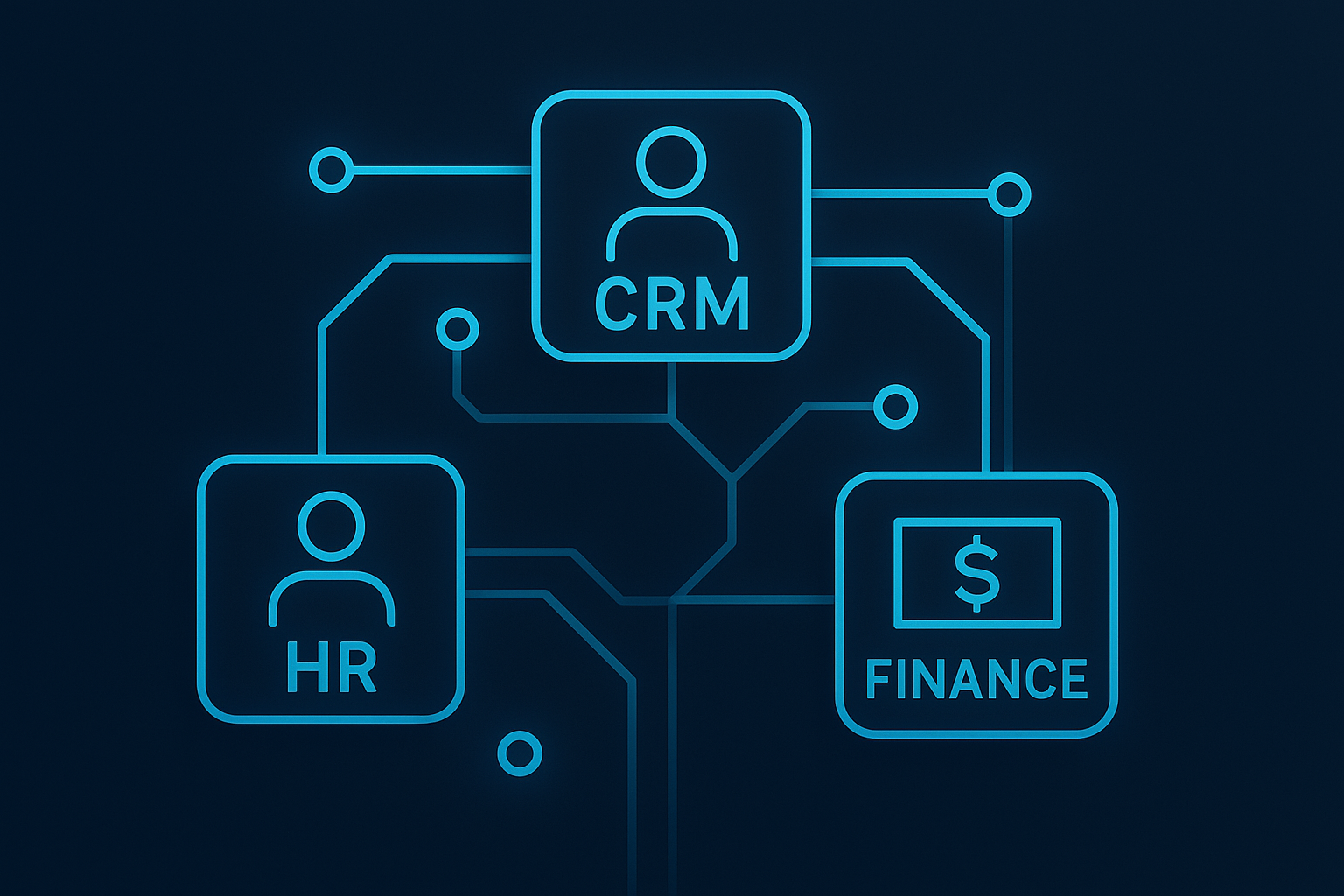
Self-hosted business management software unifies modules on one secure data layer.
Frequently Asked Questions
What is self-hosted business management software?
Self-hosted business management software is a suite of tools, such as CRM, HR, finance, and inventory modules, that an organization installs and runs on its own servers or private cloud instead of a vendor's shared cloud environment. This gives the organization direct control over data storage, access, and security configuration.
How is self-hosted software different from cloud-based SaaS?
Cloud-based SaaS stores data on the vendor's servers and is maintained entirely by that vendor, while self-hosted software runs on infrastructure the customer owns or controls. As a result, self-hosted deployments offer more customization and data control but require more internal IT involvement.
Why do government and defense organizations prefer self-hosted platforms?
Government and defense teams often need air-gapped or SCIF-capable environments, strict access controls, and alignment with frameworks like CMMC. Self-hosted deployments make it possible to meet these requirements without routing sensitive data through third-party clouds.
What does it cost to self-host a business management suite?
Costs vary based on infrastructure, team size, and whether deployment is cloud-hosted or on-premise, since pricing is typically tiered around users, modules, and support level. Organizations should request a demo or quote to compare total cost against ongoing SaaS subscription fees.
How long does a self-hosted deployment take?
A straightforward deployment can take a few days to a few weeks, depending on data migration complexity and integration needs. Larger enterprise or regulated deployments with custom security requirements may take longer.
Is self-hosted business management software harder to maintain?
It generally requires more internal involvement than SaaS, since the organization or a managed-service partner handles updates, backups, and security patching. However, many vendors now offer managed self-hosted options that reduce this burden significantly.
Can self-hosted platforms still receive updates and support?
Yes, reputable vendors release regular updates and offer dedicated support plans for self-hosted customers, often including SLAs for enterprise deployments. Updates are typically applied during scheduled maintenance windows controlled by the customer.
What security standards should a self-hosted suite meet?
Look for role-based access control, encryption in transit and at rest, audit logging, and alignment with recognized frameworks such as the NIST Cybersecurity Framework or CMMC. Post-quantum cryptography support is increasingly important for long-term data protection.
What modules are typically included in a business management suite?
Most suites include CRM, HR, finance, project management, inventory, procurement, and document management on a shared data layer. Some platforms, like Eden Biz, bundle 20 or more modules so teams avoid stitching together separate tools.
What are common mistakes companies make when self-hosting?
Common mistakes include underestimating infrastructure needs, skipping a formal access-control plan, and failing to budget for ongoing maintenance. Organizations also sometimes delay testing data migration, which can cause downtime during cutover.
Can small businesses benefit from self-hosted software, or is it only for enterprises?
Small businesses and freelancers can benefit too, especially when data ownership or compliance matters more than convenience. Many vendors now offer scaled-down or cloud-hosted self-hosted options that fit smaller budgets.
How does self-hosting affect data ownership?
With self-hosted business management software, the organization retains full ownership of its data because it never leaves infrastructure the organization controls. This contrasts with multi-tenant SaaS, where data often resides on servers shared with other customers.
What is the difference between self-hosted and on-premise software?
On-premise specifically means the software runs on physical hardware inside the organization's own building, while self-hosted is a broader term that also includes private cloud or dedicated infrastructure the organization controls. In practice, the two terms overlap heavily.
Does self-hosted software support integrations and APIs?
Yes, most modern self-hosted platforms expose APIs for integrating with accounting tools, identity providers, and AI gateways. This lets organizations connect existing systems without migrating everything at once.
Final Thoughts
Choosing self-hosted business management software ultimately comes down to how much control an organization needs over its own data. For regulated industries, government contractors, and privacy-conscious businesses, that control is not optional. In addition, the right platform should unify CRM, HR, finance, and operations on one data layer rather than forcing teams to juggle disconnected tools.
Above all, a successful move to self-hosted business management software depends on careful planning: assessing infrastructure, locking down access controls, validating migrated data, and training teams before go-live. Platforms such as Eden Biz, paired with a governed AI layer like AOCore, give organizations a practical path toward that control without sacrificing modern functionality.
