CAC/PIV integrated AI is becoming a baseline requirement for government agencies and defense contractors that need to deploy artificial intelligence tools without creating new security gaps. Common Access Card (CAC) and Personal Identity Verification (PIV) credentials already control access to classified networks, email, and building systems across the Department of Defense and federal civilian agencies. Therefore, AI platforms that cannot plug into this existing identity infrastructure introduce risk rather than reduce it. This article explains what CAC/PIV integrated AI actually means, how it works in practice, and why it matters for anyone building or buying AI for government or defense use.
What Is CAC/PIV Integrated AI?
CAC/PIV integrated AI is an artificial intelligence system that authenticates users through their existing Common Access Card or Personal Identity Verification smart card instead of a separate username and password. In practice, a government employee inserts their CAC into a card reader, enters a PIN, and gains access to AI chat, search, or automation tools using the same credential that unlocks their workstation. As a result, agencies avoid creating a parallel identity system that attackers could target separately.
Both CAC and PIV credentials follow the FIPS 201 standard maintained by NIST, which defines how smart card certificates are issued, validated, and revoked. The Common Access Card is issued to military personnel and DoD contractors, while PIV cards go to civilian federal employees. Consequently, any AI platform marketed to government customers needs to speak the same PKI language these cards already use, rather than forcing a second login system on top of it.

CAC/PIV integrated AI lets staff log in with the same smart card they already use for other secure systems.
Why CAC/PIV Authentication Matters for Government AI Tools
Federal identity policy has required strong, card-based authentication for sensitive systems for many years, and AI tools are no exception. The Department of Defense has issued CAC credentials to millions of active personnel, contractors, and civilians, according to DoD identity management data, which means any new AI system touching DoD networks must account for that population. Similarly, civilian agencies lean on PIV cards for the same purpose under federal identity assurance guidelines.
Without CAC/PIV authentication, an AI vendor forces agencies into one of two uncomfortable choices. First, they could issue a brand-new password-based account for every user, multiplying the number of credentials an attacker might try to steal. Alternatively, they could skip strong authentication altogether, which conflicts with baseline federal security requirements. In contrast, CAC/PIV integrated AI closes that gap by reusing an identity proof the government already trusts, audits, and revokes when needed.
This matters even more as agencies connect AI to sensitive records through retrieval-augmented search or document management. For example, an AI workspace with persistent memory and knowledge-base search, like AOCyber's AODex, only stays safe if the person behind every query is verifiably who they claim to be.
How CAC/PIV Integration Works With an AI Gateway
Integrating CAC/PIV authentication into an AI gateway follows a fairly consistent technical path, even though implementation details vary by vendor. The steps below outline the general process.
- Register the AI gateway with agency identity infrastructure. Connect the gateway to existing PKI and directory services so it recognizes CAC/PIV certificates issued by a trusted federal authority during login attempts.
- Configure the smart card reader and PKI middleware. Install reader hardware and middleware on endpoints so users can insert a card and enter a PIN to start authentication.
- Map CAC/PIV certificates to AI access roles. Assign each authenticated identity to a role that controls which models, data sources, and features that person can use.
- Enforce guardrails and logging tied to the authenticated identity. Apply content guardrails and tokenization so every AI interaction is filtered and logged against a verified identity.
- Monitor and audit authenticated sessions. Review logs, certificate revocation events, and usage patterns regularly to confirm the integration stays secure over time.
Core Security Features Alongside CAC/PIV Smart Card Access
CAC/PIV smart card access answers the question of who is logging in, but it does not by itself control what happens after login. Therefore, agencies need governance layers working alongside the authentication step. Content guardrails screen prompts and responses for policy violations, while jailbreak and prompt-injection detection catch attempts to manipulate the model into bypassing restrictions.
PII tokenization is another essential layer, since authentication alone cannot prevent sensitive data from leaking into AI outputs or logs. As explained in more detail in this breakdown of why PII detection alone falls short, agencies need tokenization and governance working together with identity controls, not as a replacement for them. AOCyber's AOCore gateway combines CAC/PIV and DISA-aligned authentication with its AOSentry security layer to cover both sides of that equation.
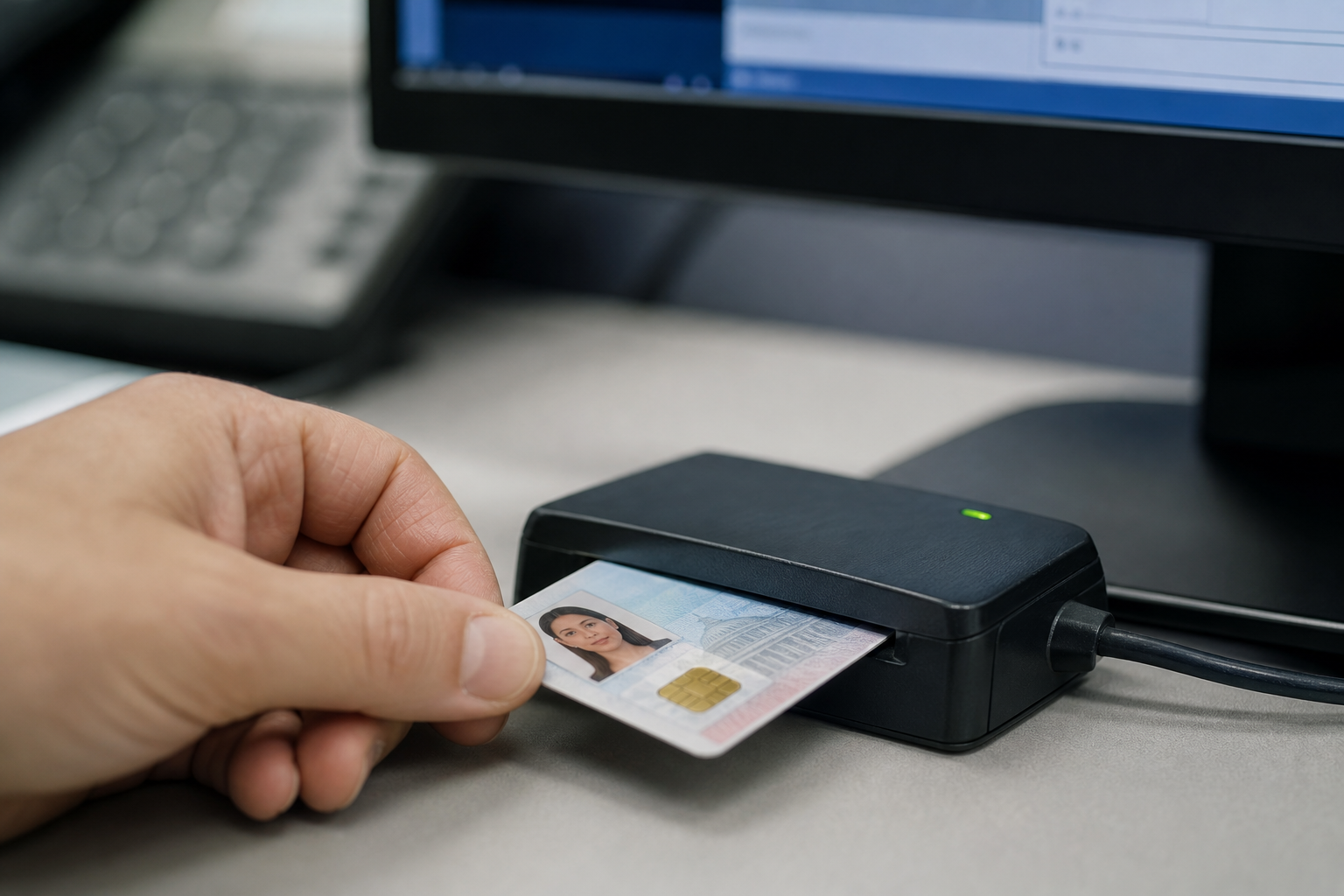
Smart card readers validate CAC and PIV certificates before granting access to AI tools.
CAC/PIV Integrated AI vs. Password-Based AI Access
The difference between CAC/PIV integrated AI and ordinary password-based access becomes clear when compared side by side.
| Factor | CAC/PIV Integrated AI | Password-Based AI Access |
|---|---|---|
| Identity strength | Hardware-backed PKI certificate plus PIN | Shared secret vulnerable to phishing |
| Credential sprawl | Reuses an existing federal credential | Adds a new account to manage and protect |
| Compliance fit | Aligns with DISA and CMMC identity controls | Often requires compensating controls |
| Revocation | Tied to agency-wide card revocation lists | Depends on vendor-specific account resets |
Compliance Requirements: CMMC, IL5, and Post-Quantum Cryptography
CAC/PIV integration rarely stands alone in a compliance program; it typically sits alongside several other requirements. Defense contractors working toward CMMC Level 3 need documented access controls, and CAC/PIV authentication helps satisfy those identification and authentication practices. For a deeper look at how this fits into a full compliance picture, see this guide to CMMC compliant AI software for defense contractors.
IL5-deployable systems add further requirements around hosting, encryption, and data segregation. In particular, post-quantum cryptography standards such as CNSA 2.0 are increasingly expected for systems protecting controlled unclassified or higher-sensitivity information, since current encryption methods may eventually be broken by quantum computers. Readers who want the broader context on securing AI across a government environment can review this complete guide to secure AI for government agencies.
Choosing a CAC/PIV-Enabled AI Platform
When evaluating a CAC/PIV-enabled AI platform, agencies should look beyond the login screen. Above all, confirm the vendor can document how certificates are validated, how revocation is handled, and whether the deployment can run air-gapped when required. AOCyber's government-grade AOCore, detailed on its government and defense product page, is built specifically around CAC/PIV and DISA authentication, IL5-deployable infrastructure, and classified content detection for SCIF-capable environments.
Similarly, procurement teams should ask vendors for specifics rather than marketing language. A platform that genuinely supports CAC/PIV integrated AI should be able to walk through certificate mapping, role-based access, and audit logging in detail, not just claim general "government readiness."

Ongoing monitoring keeps CAC/PIV integrated AI deployments aligned with federal security expectations.
Frequently Asked Questions About CAC/PIV Integrated AI
What is CAC/PIV integrated AI?
CAC/PIV integrated AI is an artificial intelligence platform that authenticates users through their existing Common Access Card or Personal Identity Verification smart card instead of a separate login. This lets agencies control AI access with the same credential used for networks, email, and facilities.
How does CAC/PIV integrated AI differ from standard single sign-on?
Standard single sign-on typically relies on a username, password, or software token tied to a corporate directory. CAC/PIV integration instead uses a physical smart card and PIN validated against PKI certificates, which is a stronger, hardware-based identity proof.
Why do federal agencies require CAC/PIV authentication for AI tools?
Federal agencies require CAC/PIV authentication because it ties every AI session to a verified individual, satisfying identity assurance mandates for government networks. Without it, agencies would need a separate, weaker credential system just for AI access.
How long does it take to deploy CAC/PIV integration with an AI gateway?
A straightforward integration with an existing AI gateway can often be configured in days to a few weeks, depending on PKI middleware and network readiness. Air-gapped or SCIF environments typically take longer due to additional accreditation steps.
What is the cost of adding CAC/PIV authentication to an AI platform?
Cost varies by platform, but CAC/PIV authentication is usually included as a security feature rather than billed separately on government-focused AI tiers. Agencies should still budget for smart card readers and middleware if those are not already in place.
What common mistakes do agencies make when integrating CAC/PIV with AI systems?
A common mistake is treating CAC/PIV login as the only security control while ignoring content guardrails and audit logging. Another is choosing a vendor that cannot clearly document certificate validation and revocation handling.
Can CAC/PIV integrated AI work in air-gapped or SCIF environments?
Yes, CAC/PIV integrated AI can be deployed in air-gapped or SCIF-capable environments when the platform supports on-premises or classified-network deployment. This requires local PKI validation services since external certificate authorities are unreachable.
Does CAC/PIV integrated AI meet CMMC Level 3 requirements?
CAC/PIV integration supports several CMMC Level 3 access control requirements, but it is one piece of a broader compliance program. Agencies still need documented policies, encryption, and continuous monitoring for full alignment.
What is the difference between CAC and PIV credentials?
CAC is issued specifically to Department of Defense personnel and contractors, while PIV is issued to civilian federal employees and contractors. Both follow the same FIPS 201 technical standard and function similarly for authentication.
How does post-quantum cryptography relate to CAC/PIV integrated AI?
Post-quantum cryptography protects the encrypted channels and stored data behind a CAC/PIV integrated AI system against future quantum computing threats. Standards such as CNSA 2.0 guide agencies toward algorithms designed to remain secure long-term.
What best practices should agencies follow when rolling out CAC/PIV integrated AI?
Agencies should map CAC/PIV identities to role-based access before launch, enable detailed audit logs, and pair authentication with content guardrails. Testing certificate revocation handling before full rollout also reduces operational risk.
Can contractors in the Defense Industrial Base use CAC/PIV integrated AI?
Yes, Defense Industrial Base contractors that hold CAC or PIV credentials can use CAC/PIV integrated AI platforms designed for DoD and DIB environments. This supports CMMC alignment while keeping contractor access traceable to a verified identity.
Is CAC/PIV integration required for IL5 AI deployments?
IL5 deployments generally require strong identity verification, and CAC/PIV integrated AI is a practical way to meet that expectation for DoD and Intelligence Community use cases. Exact requirements depend on the authorization package and hosting environment.
What happens if an AI platform does not support CAC/PIV authentication?
Without CAC/PIV support, agencies must create and manage a separate credential just for AI access, which increases administrative burden and attack surface. It can also disqualify the platform from use cases that mandate federal identity standards.
How does AOCore support CAC/PIV integrated AI for government agencies?
AOCore is built for government-grade deployments with CAC/PIV and DISA-aligned authentication, IL5-deployable infrastructure, and CNSA 2.0 post-quantum cryptography. It pairs that identity layer with AOSentry governance controls such as PII tokenization and jailbreak detection.
Bringing It All Together
In summary, CAC/PIV integrated AI gives agencies a way to deploy artificial intelligence without weakening the identity controls they already depend on. Instead of adding another password to manage, it reuses a trusted federal credential and pairs that with guardrails, tokenization, and audit logging. As a result, agencies and defense contractors can move forward with AI adoption while staying aligned with CMMC, IL5, and post-quantum security expectations. For teams evaluating options, reviewing how a platform like AOCore at aocyber.ai handles CAC/PIV authentication is a practical starting point before wider rollout.

