Government-grade AI encryption is the set of cryptographic standards, key-management practices, and compliance controls that let artificial intelligence systems process classified or highly sensitive government data without exposing it to unauthorized access. Federal agencies, defense contractors, and intelligence organizations increasingly rely on large language models for daily work, yet most commercial AI tools were never built to meet military-grade security requirements. Consequently, understanding what separates true government-grade AI encryption from marketing language has become essential for anyone deploying AI inside a regulated environment.
In short: government-grade AI encryption combines NSA-approved CNSA 2.0 algorithms, post-quantum cryptography, and FIPS 140-3 validated modules with strict identity controls like CAC/PIV authentication to protect AI workloads at impact levels such as DoD IL5. It is not a single feature — it is a layered architecture spanning encryption, identity, and governance.

Government-grade AI encryption relies on layered monitoring, not just a single algorithm.
What Is Government-Grade AI Encryption, Exactly?
Government-grade AI encryption refers to cryptographic protection that meets the standards required by defense, intelligence, and federal civilian agencies rather than general commercial benchmarks. At its core sit NSA-approved algorithm suites, FIPS 140-3 validated cryptographic modules, and documented key-management lifecycles. In addition, it extends to how data is isolated, who can authenticate into the system, and how long encrypted material remains secure against future decryption attempts.
Unlike a typical software feature, this is a layered architecture. For example, a platform might encrypt data at rest and in transit using CNSA 2.0 algorithms published by the National Security Agency, while also enforcing hardware-backed identity verification. Therefore, evaluating government-grade AI encryption means looking well past a vendor's headline claim and checking which specific standards are actually implemented.
Why Everyday AI Encryption Isn't Enough for Sensitive Data
Most consumer and commercial AI tools rely on AES-256 for storage and TLS for transmission. These are solid, widely trusted protections for everyday business use. However, they were never designed with classified handling, long-term quantum resistance, or federal audit requirements in mind.
In particular, many popular AI platforms also retain conversation data for model training or analytics, a practice that creates risk regardless of how strong the underlying encryption is. As a result, agencies that assume a vendor's privacy policy is a substitute for a real security architecture often discover gaps only after sensitive data has already been exposed. A deeper look at this problem is covered in why an AI provider's privacy policy is not a security strategy. Similarly, encryption that protects data at rest does nothing to stop manipulation of a model's behavior once a request reaches it, which is why governance controls matter just as much as the cipher suite itself.
The Core Cryptographic Standards Behind Government-Grade AI Encryption
Three standards tend to define genuine government-grade AI encryption. First, CNSA 2.0 — the NSA's current approved algorithm suite — sets the baseline for protecting national security systems. Second, post-quantum cryptography addresses a looming risk: data encrypted today with conventional methods could be harvested now and decrypted later once quantum computers mature. Specifically, NIST finalized three post-quantum standards — FIPS 203, 204, and 205 — in August 2024, and the NSA's CNSA 2.0 transition timeline calls for national security systems to fully adopt quantum-resistant algorithms by 2033. Third, FIPS 140-3 validation confirms that the actual cryptographic modules, not just the algorithms on paper, have been independently tested.
For further background on cryptographic fundamentals, the Wikipedia entry on post-quantum cryptography offers useful context. The table below summarizes how these requirements typically differ from standard commercial encryption.
| Feature | Commercial AI Encryption | Government-Grade AI Encryption |
|---|---|---|
| Algorithm suite | AES-256, TLS | CNSA 2.0, post-quantum algorithms |
| Module validation | Varies, often unvalidated | FIPS 140-3 validated |
| Identity verification | Username/password, SSO | CAC/PIV, DISA-aligned identity |
| Deployment options | Multi-tenant cloud | Air-gapped / SCIF-capable |
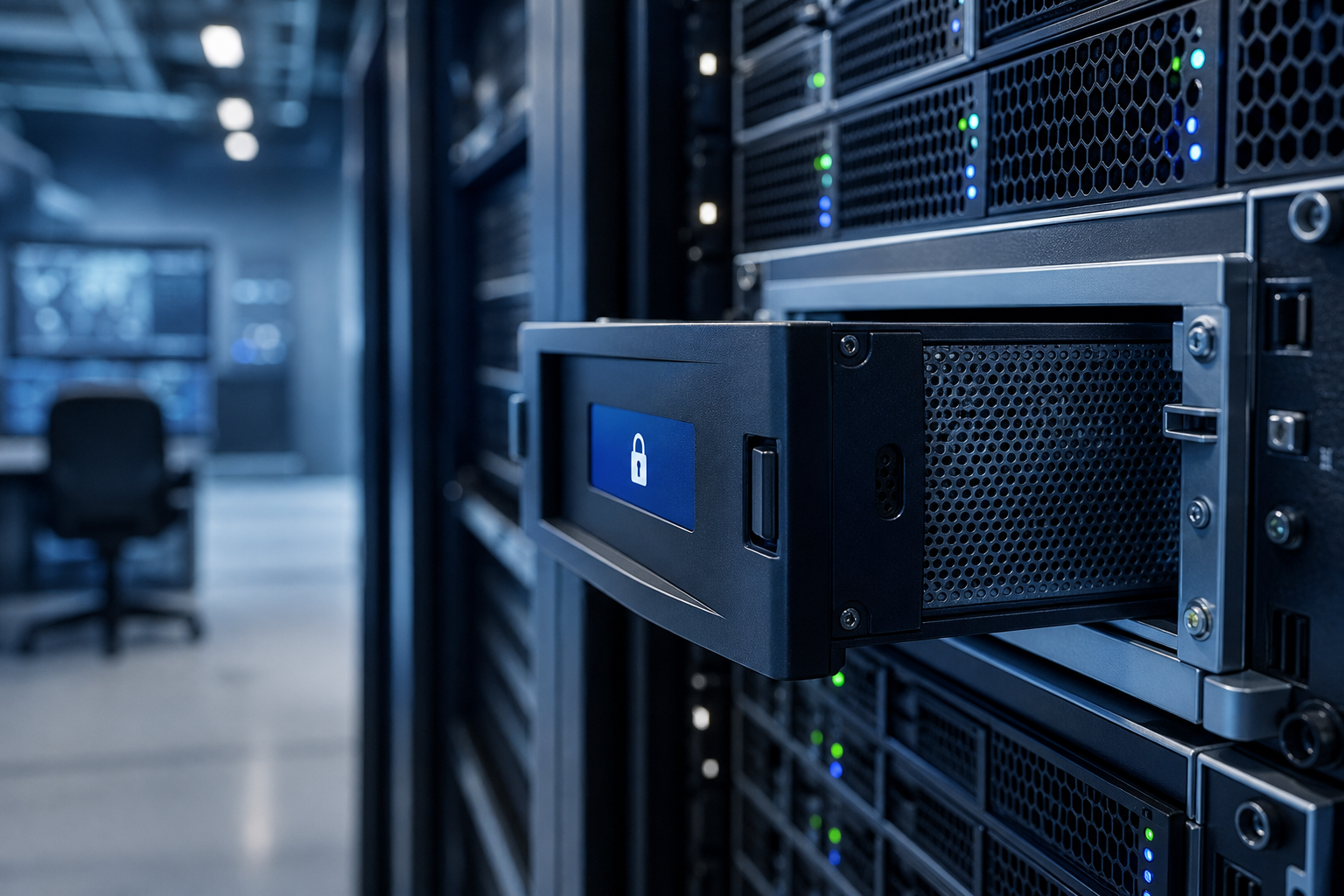
Validated cryptographic hardware underpins reliable government-grade AI encryption deployments.
How Government-Grade AI Encryption Supports Compliance Frameworks
Encryption alone does not satisfy federal compliance; instead, it must align with specific frameworks that agencies and contractors are already obligated to follow. CMMC Level 3, for instance, builds on NIST SP 800-172 and requires defense contractors handling Controlled Unclassified Information to demonstrate advanced protections well beyond basic cybersecurity hygiene. The Department of Defense's CMMC program overview outlines these tiered requirements in detail.
Similarly, DoD Impact Level 5 (IL5) sets specific encryption, isolation, and access requirements for systems handling sensitive but unclassified national security data. Consequently, an AI platform that claims to be "secure" but cannot point to IL5-deployability, CMMC alignment, or a documented path toward relevant authorizations should be treated cautiously. Readers evaluating a full agency rollout may also find it helpful to review this complete guide to secure AI for government agencies, which walks through these requirements in more depth.
Beyond Encryption: Governance Layers That Protect AI Systems
Strong cryptography protects data while it sits in storage or moves across a network, but it cannot stop someone from manipulating a model's behavior once a request reaches it. That is why mature government-grade AI encryption deployments pair cryptography with governance controls. PII tokenization, for example, replaces identifying details with non-reversible tokens before any data reaches the model, shrinking exposure even further.
Content guardrails and jailbreak or prompt-injection detection add another layer, catching attempts to trick a model into bypassing its own safety rules. For a closer look at this specific risk, see how jailbreak detection protects enterprise AI. Together, these governance measures close gaps that encryption by itself was never designed to address, which is precisely why agencies should evaluate the full stack rather than a single cryptographic claim.
How to Evaluate a Government-Grade AI Encryption Solution
Agencies and contractors can follow a structured process when assessing whether a platform genuinely meets government-grade requirements rather than simply marketing itself that way.
- Identify the data classification level your AI workload will handle, from unclassified controlled information up to IL5 or higher, because the required cryptographic suite changes at each tier.
- Confirm the vendor uses NSA-approved CNSA 2.0 algorithms and FIPS 140-3 validated cryptographic modules rather than generic AES encryption marketed loosely as enterprise-grade.
- Check whether the platform supports post-quantum cryptography, since NIST's FIPS 203, 204, and 205 standards are becoming the baseline for long-term protection against future quantum attacks.
- Verify alignment with CMMC Level 3 and NIST SP 800-172 controls if the deployment touches Controlled Unclassified Information or Defense Industrial Base contracts.
- Ask whether the system can run in air-gapped or SCIF-capable environments and supports CAC or PIV smart-card authentication for strong identity verification.
- Review governance features such as PII tokenization, content guardrails, and jailbreak or prompt-injection detection, since encryption alone cannot stop misuse once data is unlocked for processing.
Choosing a Provider Built for Government-Grade AI Encryption
Few AI gateways are designed from the ground up for this level of protection. AOCyber's AOCore gateway, for example, routes requests to more than 500 models through a single OpenAI-compatible API while enforcing AOSentry security and governance — including PII tokenization, content guardrails, and jailbreak or prompt-injection detection. Its government-grade configuration is built for IL5-deployable environments, uses CNSA 2.0 post-quantum cryptography, aligns with CMMC Level 3, and supports air-gapped or SCIF-capable deployments alongside CAC/PIV and DISA-aligned identity verification.
Notably, this is distinct from FedRAMP authorization, which AOCyber is currently pursuing rather than holding today — a distinction agencies should always confirm directly with any vendor. More detail on this architecture is available at AOCore for government and defense, and background on the broader platform appears in introducing AOCyber Systems. Organizations exploring options broadly can also start at AOCyber to compare deployment models.

Reviewing compliance documentation is a core part of vetting government-grade AI encryption claims.
Frequently Asked Questions About Government-Grade AI Encryption
What is government-grade AI encryption?
Government-grade AI encryption is a layered set of cryptographic standards, key-management practices, and identity controls designed to protect AI systems that handle classified or highly sensitive government data. It typically combines NSA-approved algorithms, post-quantum cryptography, and FIPS-validated modules.
How does government-grade AI encryption differ from standard commercial encryption?
Standard commercial encryption usually relies on AES-256 and TLS for data in transit and at rest, which is adequate for general business use. Government-grade encryption adds NSA-approved CNSA 2.0 algorithms, post-quantum resistance, and stricter key-management and audit requirements.
Why do federal agencies need government-grade AI encryption?
Federal agencies handle classified, controlled, or mission-critical data that cannot be exposed through weak encryption or opaque vendor practices. Government-grade protections reduce the risk of interception, unauthorized retention, or future decryption by quantum-capable adversaries.
What is CNSA 2.0 and why does it matter for AI systems?
CNSA 2.0 is the National Security Agency's current suite of approved cryptographic algorithms for protecting national security systems. AI platforms that support CNSA 2.0 can process sensitive data using the same cryptographic baseline required for defense and intelligence networks.
How does post-quantum cryptography protect AI workloads?
Post-quantum cryptography uses mathematical problems that remain hard to solve even for future quantum computers, unlike today's widely used RSA or elliptic-curve methods. Applying it to AI workloads protects data captured now from being decrypted later once quantum computing matures.
What compliance frameworks require government-grade AI encryption?
CMMC Level 3, NIST SP 800-172, and DoD Impact Level 5 (IL5) all require encryption and access controls beyond typical commercial baselines. Organizations in the Defense Industrial Base often must meet these frameworks to handle Controlled Unclassified Information.
Does government-grade AI encryption guarantee FedRAMP authorization?
No, encryption strength and FedRAMP authorization are separate things. A platform can use government-grade AI encryption while still pursuing or lacking a specific FedRAMP authorization, so agencies should verify both the cryptographic standards and the authorization status directly with any vendor.
How much does it cost to deploy government-grade AI encryption?
Costs vary widely based on deployment model, from cloud subscriptions with built-in compliance features to dedicated, self-hosted, or air-gapped infrastructure with custom service-level agreements. Enterprise and government deployments generally involve tiered or custom pricing rather than a flat rate.
How long does it take to implement government-grade AI encryption in an agency environment?
Timelines depend on the deployment type, ranging from a few weeks for cloud-based rollouts to several months for air-gapped or SCIF-capable installations that require accreditation. Integration with existing identity systems like CAC or PIV can also extend the timeline.
What are common mistakes agencies make when evaluating AI encryption claims?
A common mistake is assuming marketing terms like "military-grade" or "bank-level" encryption automatically meet federal requirements. Agencies should instead verify specific standards such as FIPS 140-3 validation, CNSA 2.0 support, and documented compliance alignment.
What is Impact Level 5 (IL5) and how does it relate to AI encryption?
DoD Impact Level 5 is a Department of Defense classification for systems handling controlled unclassified or national security information requiring heightened protection. AI platforms that are IL5-deployable must meet stricter encryption, isolation, and access-control requirements than lower impact levels.
Can government-grade AI encryption work in air-gapped or SCIF environments?
Yes, properly architected government-grade AI platforms can run in air-gapped networks or Sensitive Compartmented Information Facilities without external connectivity. This requires on-premises model hosting, local key management, and encryption that does not depend on outside cloud services.
What role does PII tokenization play in government-grade AI encryption?
PII tokenization replaces sensitive identifiers with non-reversible tokens before data reaches an AI model, reducing exposure even if encryption were somehow bypassed. It works alongside encryption as an additional governance layer rather than replacing it.
How does jailbreak and prompt-injection detection support encryption efforts?
Encryption protects data while it is stored or transmitted, but it cannot stop manipulation once a model processes a request. Jailbreak and prompt-injection detection monitors inputs and outputs for manipulation attempts, closing a gap that encryption alone cannot address.
What should agencies look for when selecting an AI gateway with government-grade encryption?
Agencies should confirm FIPS-validated cryptographic modules, CNSA 2.0 and post-quantum support, CMMC alignment, and governance features like content guardrails and PII tokenization. It also helps to check whether the vendor supports air-gapped deployment and CAC or PIV-based identity verification.
Final Thoughts on Government-Grade AI Encryption
Ultimately, government-grade AI encryption is not a marketing checkbox — it is a layered combination of approved algorithms, validated cryptographic modules, post-quantum readiness, and identity and governance controls working together. Agencies and contractors evaluating AI tools should look past generic claims and verify specific standards like CNSA 2.0, FIPS 140-3, CMMC Level 3, and IL5-readiness before trusting any platform with sensitive data. In the end, strong cryptography paired with governance features such as PII tokenization and jailbreak detection offers the most realistic path to deploying AI safely inside regulated government environments.

