AI HR management software is a human resources platform that uses machine learning and language models to automate routine people-operations work. It handles tasks like onboarding, employee records, policy questions, and reporting. This guide explains what it does, where the risks sit, and how to choose a tool that protects employee data.
Quick answer: Pick AI HR management software by matching it to your real workflows, then verify how it stores and uses employee data. Privacy terms matter as much as features.
What Is AI HR Management Software?
It is an HR system of record with an intelligence layer on top. The record holds profiles, contracts, leave, and payroll inputs. The AI layer drafts content, answers questions, and surfaces patterns.
In contrast, a traditional HR information system (HRIS) mainly stores and organizes data. People still write every letter and build every report by hand.
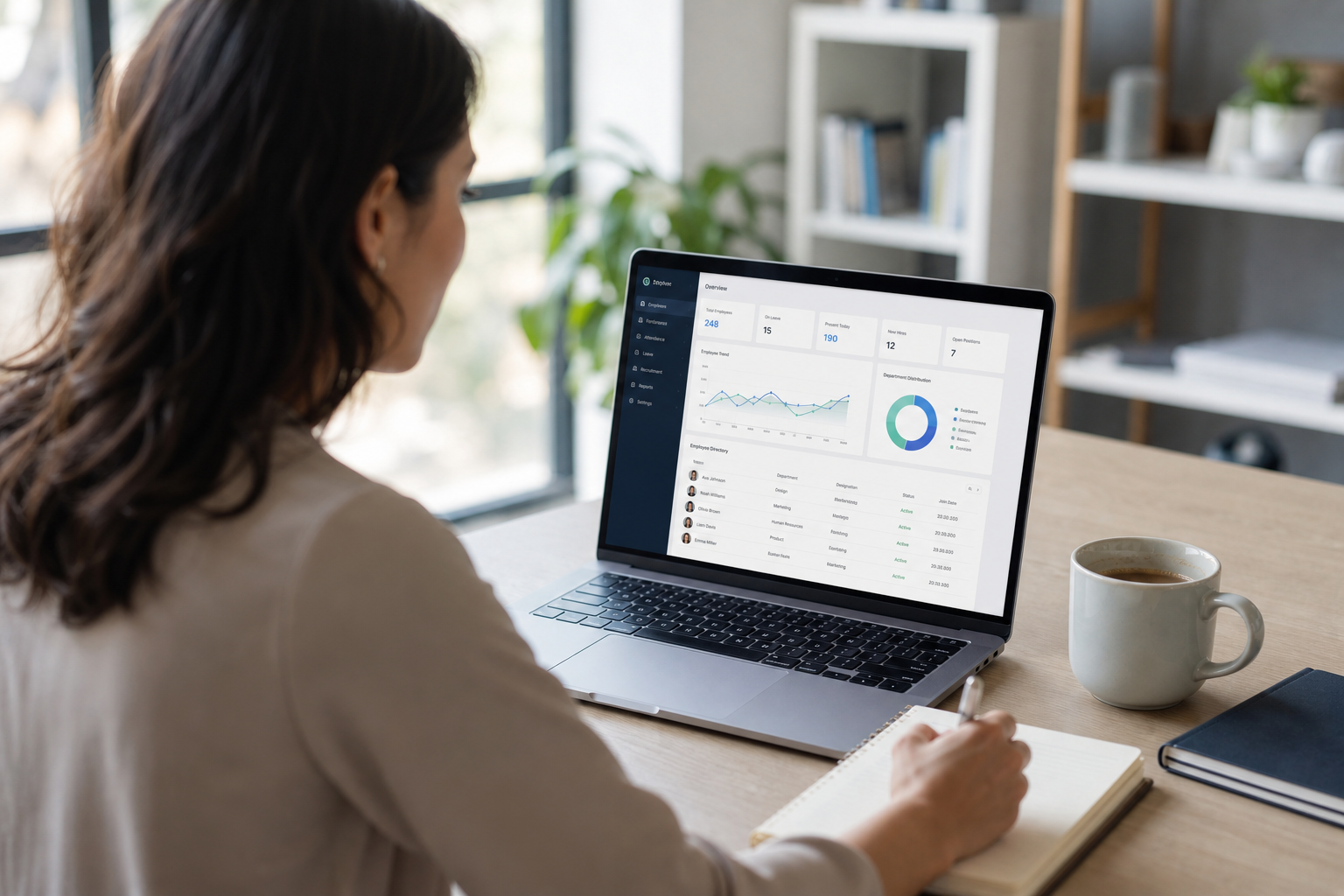
An HR professional reviews workforce data in AI HR management software.
Core Features of AI-Powered HR Platforms
Employee Records and Onboarding
Digital files, document storage, and checklists keep new hires on track. AI can draft welcome messages and flag missing paperwork. As a result, HR spends less time chasing forms.
Self-Service Answers
Employees ask about leave, benefits, or policy and get an answer grounded in company documents. This is often called retrieval-augmented generation (RAG), meaning the AI looks up your own files before replying.
Reporting and Analytics
Dashboards track headcount, turnover, and time off. In addition, AI can summarize trends in plain language for leaders who do not read spreadsheets.
Privacy and Compliance Risks to Check
HR data is among the most sensitive a company holds. It includes pay, health notes, and performance records. Therefore, ask every vendor three questions in writing.
- Is employee data ever used to train models or sold?
- Who can see which records, and is access role-based?
- Can we choose cloud or self-hosted deployment?
Bias is the other risk. The National Institute of Standards and Technology (NIST) publishes an AI Risk Management Framework that helps organizations assess such risks. Meanwhile, the Society for Human Resource Management (SHRM) offers practical HR guidance on using automation responsibly. Keep a person in the loop for hiring, discipline, and termination decisions.
Unapproved tools are a related problem. Staff may paste HR data into public chatbots, which is covered in our piece on shadow AI in the enterprise.
Standalone HR Tool or Integrated Suite?
A standalone tool can go deep on one function. However, it often creates duplicate data entry with finance and project systems. An integrated suite keeps one data layer, so a new hire appears in payroll inputs, projects, and access rules without re-keying.
For example, Eden Biz from aocyber.ai is an AI-native business management suite. It combines HR with CRM, finance, projects, inventory, procurement, and document management on a single data layer, with role-based access and APIs. Teams planning wider rollouts can also read about AI project management tools and procurement AI software.

Evaluating HR platforms is easier when the whole team maps its workflows first.
How to Choose HR Management Software With AI
- Map your HR workflows. List repeated tasks and rank them by time spent.
- Set privacy requirements. Define access roles, hosting, retention, and a ban on training models with your data.
- Shortlist vendors. Compare three to five options and get written answers on data handling.
- Run a pilot. Test with a small group and measure time saved and accuracy.
- Roll out and train. Migrate data in phases and review results after the first quarter.
Privacy-First Deployment Options
Where the software runs affects your risk. Cloud deployment is faster to start. Self-hosted deployment keeps records inside your own environment, which suits regulated or security-sensitive organizations. Ask whether a vendor supports both, and whether enterprise buyers can get dedicated infrastructure and service-level agreements.
If you also want an AI assistant that stays under your control, see this overview of a private AI workspace.
Frequently Asked Questions
What is AI HR management software?
AI HR management software is a human resources platform that uses machine learning and language models to automate tasks such as onboarding, records, scheduling, and reporting. It sits on top of a core HR system of record.
How is it different from a traditional HRIS?
A traditional HRIS stores and organizes employee data. AI-enabled tools also draft documents, answer employee questions, flag anomalies, and summarize trends.
What tasks can AI automate in HR?
Common tasks include drafting job descriptions, answering policy questions, scheduling interviews, summarizing reviews, and preparing reports. Final decisions should stay with people.
Is AI HR management software safe for employee data?
It can be, if the vendor offers role-based access, encryption, clear data-use terms, and no training on your data. Always verify these in writing.
Can AI make hiring or firing decisions?
It should not make them alone. Automated tools can introduce bias, and some jurisdictions regulate automated employment decisions, so keep human review in place.
How much does AI HR management software cost?
Pricing varies by vendor, headcount, and modules. Most vendors charge per user or per employee, so request a written quote based on your actual team size.
How long does implementation take?
Small teams can often go live in weeks, while larger rollouts with data migration and integrations take longer. Clean source data shortens the timeline.
Should HR software be a standalone tool or part of a suite?
A suite avoids duplicate data entry between HR, finance, and projects. A standalone tool can suit teams that need deep specialization in one area.
What are common mistakes when buying HR software?
Common mistakes include skipping a privacy review, ignoring integrations, buying features nobody needs, and not training staff. A short pilot helps avoid them.
What compliance issues should HR teams consider?
Consider data protection law, anti-discrimination rules, record retention, and local rules on automated decision tools. Ask your legal counsel to review the vendor's terms.
Does AI HR management software work for small businesses?
Yes. Small businesses often benefit most because automation frees limited staff time. Choose a tool that scales with headcount and does not demand a large IT team.
Can I self-host HR software?
Some vendors offer self-hosted deployment for organizations that must keep employee data in their own environment. Ask whether cloud and self-hosted options are both available.
Conclusion
AI HR management software can cut repetitive work in onboarding, records, and reporting. The best choice fits your actual workflows, keeps a human in every high-stakes decision, and treats employee data as yours. Start with a workflow map, demand clear privacy terms, and pilot before you commit.

